

Originally published on National Geographic.
Heading to the mountains? Don’t let altitude sickness ruin it.
If you’re planning a getaway at one of these popular high-altitude destinations—from Banff to the Colorado Rocky Mountains—try acclimating in any of these “intermediate altitude” cities first.
Spending time in a medium-altitude location before going higher can help you acclimate more comfortably.
Teal Thomsen/Tiny Atlas, Kintzing
ByCari Shane
Published March 18, 2026
Altitude sickness is an equal opportunity ailment; it doesn’t discriminate by age or level of fitness. Also called “acute mountain sickness,” it can ruin a mountain vacation.
Because there is less oxygen in the air at higher elevations, less oxygen is absorbed into the blood when breathing. That leaves many people struggling, especially those coming from sea level to North America’s favorite high-altitude ski resorts and hiking destinations. Altitude sickness can sideline the susceptible for days with flu-like symptoms: nausea, vomiting, headache, and sleeplessness; others describe their symptoms as a really bad hangover which comes on hard and suddenly, even days after arriving.
Even small exertions, like walking up a flight of stairs, can leave many panting. As they try to get more oxygen, they breathe faster, and usually through their chest. “They think that breathing more is going to offset the lack of oxygen, so they get in this vicious cycle of hyperventilating, breathing into the chest, breathing through the mouth which, in the end, results in them getting even less oxygen,” says James Nestor, who wrote the New York Times best-selling book, Breath: The New Science of a Lost Art. “It off-gasses too much carbon dioxide in their bloodstreams. This causes vasoconstriction in their head, which is why they get so sick," adds Nestor. Instead, he recommends focusing on breathing deeply through the nose and belly.
Studies suggest that anywhere from 25- to 85-percent of travelers going to high- altitude locations experience altitude sickness. Contributing factors include how quickly they ascend to a higher elevation and their body’s own sensitivity and physiology.
While older travelers can experience more pronounced symptoms, especially for those with underlying health conditions, there’s a higher incidence of altitude sickness in younger travelers, statistically speaking. Researchers suggests two reasons: their belief that altitude ‘isn’t a thing’ or ‘won’t affect me because I’m fit,' which leads to them often going in too hard and fast.
To decrease the chances of getting altitude sickness, experts recommend avoiding alcohol (which dehydrates), increasing water consumption, and acclimating at a lower altitude first. Instead, give yourself a gradual adjustment by staying for about 48 hours in a medium altitude locale before heading to the mountains.
Elevation or altitude is the distance of a location above sea level. While scientists define "medium altitude” as a region that sits between 1,640 and 4,921 feet, in a state like Colorado, where there are dozens of high altitude towns—such as Leadville which sits at 10,000 feet—Denver is a moderate elevation city within the state.
Utah
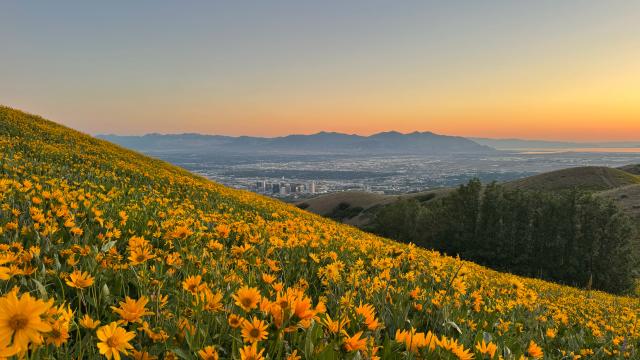
Acclimate in Salt Lake City (4,327 feet) for: Snowbird, Alta, Park City, Deer Valley and Snowbasin
In addition to a large, year-round trail system, Salt Lake City has a variety of walkable neighborhoods. The Granary District, one of the city's oldest areas, has an artsy blend of industrial history and modern design. 900 South and its main thoroughfare, Harvey Milk Boulevard, is a hub for the city's LGBTQ+ community. Downtown Salt Lake, walkable and compact, is where you can catch a Broadway show at Eccles Theater or a performance by the Utah Symphony. Visit Salt Lake attraction passes gives discounts on museums, cultural sites, and experiences.
Salt Lake is one of the easiest mountain-gateway cities to navigate car-free. The TRAX light rail connects the airport to the city, and the UTA Ski Bus offers free rides for those with the Salt Lake Ski Super Pass or Ikon Pass—a global ski pass.
Visit Salt Lake (VSL) is the private, nonprofit Destination Sales & Experience Organization (DSXO) dedicated to recruiting, retaining, and activating conventions, meetings, sporting events and leisure travel that fuels the region’s visitor economy. In partnership with Salt Lake County, hoteliers, members and public-sector stakeholders, VSL helps generate $6.15 billion in annual visitor spending, $575 million in direct tax revenue and $1,700 in household tax savings while supporting more than 56,000 jobs. By championing Salt Lake's authentic urban-meets-mountain identity, VSL creates transformative experiences that benefit the community and visitors alike. For more information, visit www.VisitSaltLake.com.