

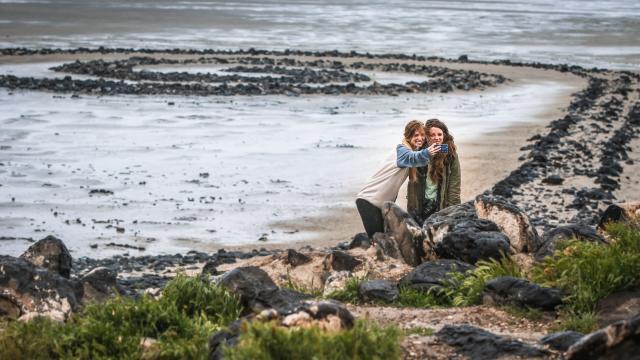
The land art movement, characterized by large-scale, site-specific works, gained popularity in the '60s and '70s. “Artists moved beyond the traditional gallery to create large-scale works in the landscape itself,” Ann Wolfe, Nevada Museum of Art curator, says. Some pieces have a temporary lifespan, but fortunately, there are long-lasting land art works that can be visited in remote, somewhat impenetrable places. Heading out on a road trip? Exploring Route 66 ahead of its 100th anniversary? Here’s where to see land art pieces in the United States.
Land art in the U.S. that's worth the journey
Nancy Holt
Photograph: Flickr
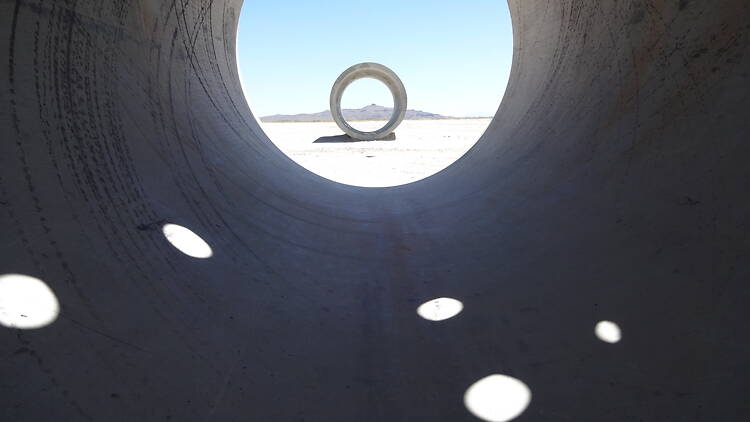
Nancy Holt installed Sun Tunnels from 1973 to 1976 in the heart of Utah’s Great Basin Desert. It consists of four gigantic concrete tubes drilled with holes aligned with constellations. The formation encircles the sun on the horizon during the solstices. Wolfe shares that Holt’s art is driven by the artist’s interest in perception, time, space, and humanity’s relationship to the natural world.
In 1979, Holt created Star-Crossed at Miami University’s sculpture park in Ohio, based on the observation that true north and magnetic north meet at Oxford, Ohio. Wolfe notes Holt often used tunnels, framed views, celestial alignments, and observational structures to shift viewer awareness of their place within the universe.
Robert Smithson
Photograph: Shutterstock
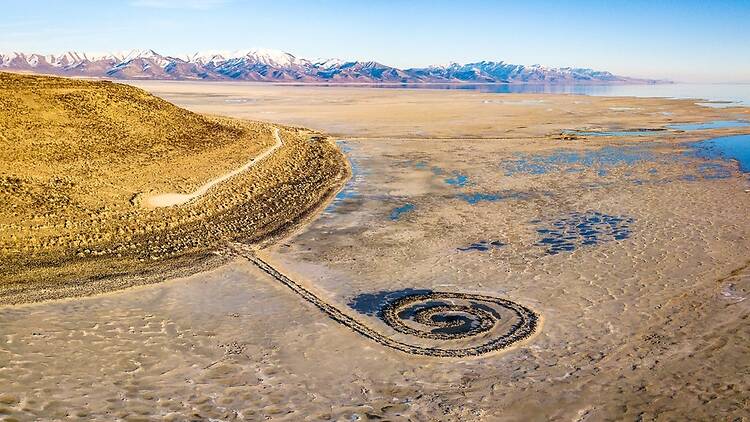
Holt’s husband, Robert Smithson, created the Spiral Jetty on Utah’s Great Salt Lake shore in 1970. The massive 1,500-foot-long counterclockwise coil was created with 6,000 tons of black basalt at Rozel Point Peninsula. Smithson embraced entropy, knowing the piece was at nature’s whim. “In 1972, rising waters submerged the work entirely for three decades before Spiral Jetty re-emerged in the early 2000s,” Emily Lawhead, Associate Curator at Utah Museum of Fine Arts, says.
Smithson died in a plane crash in 1973 while working in Texas on Amarillo Ramp at the base of an artificial lake, which Holt later completed. Though now overgrown with mesquite, Amarillo Ramp can be visited by reservation.