

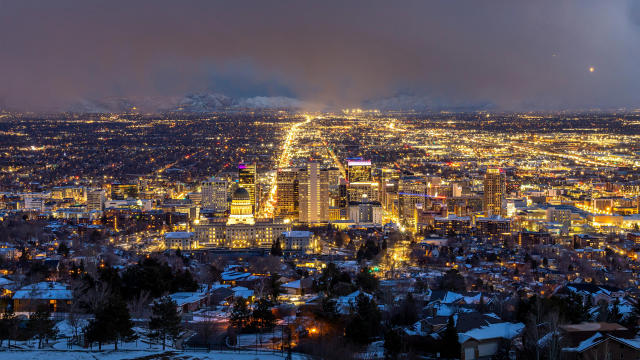
Great Escapes: Surprised in Salt Lake City
Craig OuthierMay 7, 2026

The Kilby/Asher Connection If you have a last-minute hankering for Kilby Block Party (May 15-17), the Asher Adams is an ideal basecamp – either a five-minute Uber or 10-minute scooter ride from Utah State Fairpark
The famously well-mannered Mormon metropolis is not all that it seems.
“Salt Lake City is the most linguistically diverse city in America. Did you know that?”
In fact, I did know that. Maybe. Read it somewhere, once.
“It’s because of the missionary programs,” my drinking partner continues. “The language training.”
Of course. The missionaries. Grateful for the knowledge tidbit, I nod in understanding and say something affirming, like “Yeah, that makes sense.” Who doesn’t love a good trivia tidbit? And this one I particularly love, because let’s be honest: Salt Lake City, and the whole of Utah for that matter, does not have a historical reputation for diversity, linguistic or otherwise. As the de facto capital of the Church of Jesus Christ of Latter-Day Saints (and factual capital of Utah), this scenic, well-mannered city has long been viewed as a monoculture. Mormon, mostly conservative and collectivist to a degree not seen in any other major American city.
So, it’s a fun surprise to learn about the bounty of languages. Who doesn’t love a fun surprise?
Then again, I’m sucking down a Manhattan in a gorgeous, early-century train station that some clever person converted into a boutique hotel, about to ride an electric scooter to an indie rock festival where my favorite synth-rock band is headlining, on an absolutely impeccable late-spring afternoon. So, what really constitutes a “surprise” in Salt Lake City anymore? I came here a few times as a kid and young adult. In college, I remember having a hard time finding a place to buy a six-pack. Now there are taprooms up and down North Temple Street.
So, the city has obviously changed, loosened up, diversified. But the trip is young, and SLC still has a few surprises in store.
Surprise No. 1: Interesting Buildings That Aren’t Churches
Settled and founded in 1847, SLC is a lot like Phoenix when it comes to architectural interest – i.e. it’s a relatively young Western city and there’s not a lot of it. Or so people might assume.
The one truly well-known exception is the Salt Lake Temple (churchofjesuschrist.org), a truly staggering specimen of castellated Gothic architecture, with quartz monazite spires to rival any Colognian cathedral. The 133-year-old church’s handsomeness has been obscured by scaffolding since 2019 due to a multi-year seismic upgrade, but the construction is due to conclude this year, and there will be a public open house in 2027 before the temple is reconsecrated (read: made off-limits again to non-Mormons)
Less well-known, but certainly with better Manhattans, is the city’s other iconic building: the Asher Adams Salt Lake City (asheradamshotel.com), a high-end boutique hotel just down the street from the temple, set in the historical Union Pacific Depot train station.
“Set in” doesn’t really capture the ingenious preservationist melding of these two entities. In fact, the Asher Adams is built into, over and around the lovely old French Renaissance Revival depot structure, without demeaning it in the slightest. Unveiled at the hotel’s 2024 opening, a new 225-room guest tower behind the depot shoulders the hospitality heavy lifting – but it’s a “tower” in name only. You can barely even see it from the street.
The showcase energy of the remodel is completely and wholly focused on the train depot itself, which now serves as the hotel lobby – spectacular with 56-foot arched ceilings and sprawling archipelagos of comfortable couches, benches and banquettes. The depot’s original terrazzo floor is intact – ornate and visibly, excitingly patched up in places, perhaps where 1920s workmen dropped a piston rod or a caboose coupling. The age of the place tingles the imagination.
The depot’s original murals, painted on its arched ceiling coves, are also intact – including one sweeping image depicting the arrival of Brigham Young and Mormon pioneers in the Salt Lake Valley, which adds a dash of irony (and, for a lapsed Mormon such as myself, a lemon twist of guilt) to your cocktail as you sip it in the lobby’s wraparound center bar. I will ultimately splash around in several SLC watering holes during this visit, and this one will remain my favorite.

photos courtesy asher adams; Visit Utah
Part of the Marriott Autograph Collection portfolio, the hotel charmingly twists its locomotive roots into every part of its operation. Each of the four on-site dining concepts evokes train travel, from dining-car-inspired Rouser (its coal-fired kitchen churning out tender, smoked-tzatziki-drizzled lamb shank and other excellent New American concoctions) to its upstairs cocktail lounge and vinyl listening club, No. 119, named for one of the trains that first traversed the transcontinental railroad.
The hotel itself is named after cartographers John R. Asher and George H. Adams, an influential duo who produced hyper-accurate railroad maps in the industry’s Golden Age.
Oh, yeah – the rooms are terrific, too. Modern and comfortable, which isn’t always the case in hotels with historical bones.

Ensign Peak hiking
Surprise No. 2: Mucho Counterculture
I remember seeing the 1998 film SLC Punk! as a young Gen X individual and registering its depiction of mosh-pitting malcontents in the famously straitlaced city – but not really buying it. My brain wasn’t ready to accept “Salt Lake” and “punk” in the same breath.
In a similar vein, I’ve never seen any festival or performance art happening in SLC and thought to myself, “That looks ridiculously cool. I wish we had that.” That is, until laying eyes on one of the multi-day music lineups at Kilby Block Party (kilbyblockparty.com).
Staged every May, the festival is the brainchild of local promoters Nic Smith and Lance Saunders, who learned the business of booking music at Kilby Court (kilbycourt.com), a long-running all-ages music venue admired in SLC for championing the DIY ethos and helping spring up-and-coming bands. The duo launched Kilby Block Party in 2019 to celebrate the 20th anniversary of their ramshackle music club, inviting back a few acts, now big stars, who once graced Kilby Court’s stage. Names that make an indie music fan go a little dry in the mouth: Death Cab for Cutie, Vampire Weekend, Phoebe Bridgers.
The first Block Party was a one-day affair; today, it spans four days, staged at Utah State Fairpark (utahstatefair.com), a vast, multi-use campus that often hosts rodeos. In fact, one of the festival’s four stages is inside the rodeo arena. I watch synth-pop sensation Nations of Language play there on a Sunday late afternoon, grateful to sit for a moment in one of the arena’s 10,000 seats after staying upright through New Order, St. Vincent, Weezer and many others over the weekend.
Any of these names dinging your desk bell? Maybe not. You either dig indie or you don’t. But know this: Kilby has convincingly supplanted Coachella as the West’s top indie rock festival (a distinction the latter doesn’t seem to want anymore) by virtue both of its programming sensibility and awesome, alternately grassy and built-up venue. 2026 headliners include Lorde, The xx and Turnstile.
The counterculture fire that fuels Kilby burns in other parts of SLC, as well. Local LGBTQ+ folk spread their wings in summer with Utah Pride (June 5-7, utahpride.org), a three-day lollapalooza of parades, festivals and activist rallies; and the city also has a surprising streak of female empowerment, distilled most visibly at Maven Salt Lake City (mavenslc.com), an entire retail district of women-owned shops, studios, restaurants and working spaces, set on a pleasant and walkable street just south of downtown.
This is cool. I wish we had this. The thought comes to me while munching one of chef-owner Ripple Desai’s scrumptious Indian tacos at Tandoori Taqueria (thetandooritaqueria.com), a fusion fast-casual at Maven, wedged between a day spa and a record store specializing in heavy metal. Maybe SLC is punk.

Kilby Block Party
Surprise No. 3: You’ll Find Your Roots Here
On two independent occasions during my SLC weekend, a fellow visitor tells me to visit the FamilySearch Library (familysearch.org), a free-to-visit repository of genealogical material and public records, operated by the LDS church. One of them was my aforementioned drinking companion. The other is a fellow journalist in town for Kilby.
Over lunch at Tandoori Taqueria, he tells me about finding early childhood records of his Haitian-born mother using the library’s digital workstation. “It was amazing,” he says. “I’d never seen any of that material before. It was almost like it brought her alive, in a way.”
So, I go: A modern, street-facing facility within walking distance of Asher Adams, staffed by a team of friendly, retiree-age docents who will take you by the elbow to whatever part of the library interests you. For hard-core family researchers, that could be the library’s physical rows of record books, photos and forms. For me, it’s the nearby bank of computers that offer simple name-search tools.
And that’s how I find a 90-year-old newspaper article from Julesburg, Colorado, that mentions my grandmother. And my great-grandfather’s land deed from Oregon. And other artifacts about lost loved ones, some long gone, some less so. I find quite a few photos, links and family-tree details uploaded remotely by my Mormon mom, who herself passed away recently. I knew she had a passion for genealogy, but I wasn’t aware she contributed to this database.
My Mormonism was not long for this world – after all, this world has Manhattans. But I still have the church and its culture in my DNA and feel, I guess, wistful about them. And one aspect of Mormonism that continues to impress and inspire me, especially as I age, is the earnest and unequivocal belief in family. A thirst for generational knowledge and intimacy so unslakable, they pour enough for the whole country. It makes me feel proud.
I thank the white-haired docent and walk back to the hotel. SLC might have the Jazz, but it will never be New Orleans, and nor should it. It will always have the tempo, I suspect, of a bedroom community – an industry town where the industry is obedience and family. But now it also has women-owned business hubs and banging rock festivals. I look forward to coming back. Big surprise.
SLC Sip Tips
Solutions for getting your drink on in SLC.
The Bar at Asher Adams
Smack-dab in the middle of the cavernous depot lobby, the wraparound bar is primo for people-watching and for next-level cocktail science, e.g. using a subtle Chartreuse wash in its house Manhattan. asheradamshotel.com
Bar X
Downtown’s preeminent cocktail bar is a late-night hive of energy and social mixing. For a nosh: Slip over to its adjacent sister property, Beer Bar, for a formidable selection of haute hot dogs (curry, andouille, lamb and herb, to name a few). barxslc.com
The Bruce Scottish Pub
Poutine corned beef, fish and chips, and smooth, malty ales rule at this upstairs pub and sports bar near the Asher Adams. Must try dish: fish pie, a Scottish delicacy of haddock, leeks and cream, baked inside a flaky crust. brucepub.com


